Piloting large-scale socioemotional assessment in higher education
How to assess the emotional intelligence of university students consistently and objectively?
This is the challenge faced by the Colombia-based university Areandina.
Socioemotional skills (including empathy and teamwork) are in high demand in a highly competitive job market for young graduates.
(In Colombia, youth unemployment – 14.6% – is more than 6 points higher than the national average 8.2%.)
Socioemotional skills come in handy in a variety of work contexts:
- Stress management helps any worker prioritise when faced with an unexpectedly tight deadline.
- Strong communication skills can prevent misunderstandings in collaborative projects, particularly in multicultural contexts.
- Conflict-resolution abilities help employees recognise negative emotional triggers (and thus avoid activating them).
Question: How to objectively measure and develop students’ socio-emotional competencies?
Until now, the answer consisted of manual assessments complemented by interviews. But such practices show severe limitations:
- Subjectivity: Interviewers may seek information that confirms their initial impressions (confirmation bias), overlooking contradictory evidence.
- Scalability: Administering a questionnaire to 10 students is feasible, but the task is of another order for 300 students.
To sum up, socioemotional assessment is key for the University Areandina as it will give students a chance to develop their soft skills and enter more confidently the job market. Besides, it is also an opportunity for the university to strengthen its positioning in Latin America’s higher-education landscape.
Students’ essays and voice recordings become socioemotional evaluation input
Human AI, a Spanish startup, introduces a platform that assesses soft skills using Natural Language Processing (NLP).
NLP is a subfield of artificial intelligence that enables computers to understand and interpret human language.
In other words, Human AI’s tool can process students’ text or voice recording from essays, interviews, workshops, and immediately deliver an evaluation of the main behavioural traits, grouped in 5 pillars:
- Openness: Willingness to try new experiences, embrace change, and accept different ideas.
- Conscientiousness: Being organised and responsible involves high levels of self-discipline and goal orientation.
- Extraversion: Sociability, assertiveness, and energy.
- Agreeableness: Tendency to be cooperative, compassionate, and trusting.
- Neuroticism: How emotionally stable or unstable a person tends to be.
For an extensive international IT university infrastructure, the platform also offers multilingual features, GDPR compliance, and plug-and-play implementation.
Consequently, Areandina is chronologically able to:
Scale deployment across campuses and online programs, enabling consistent evaluation of large student populations. Be 3,000, 15,000 or ten times more.
- Personalise development pathways to support well-being, coaching, and academic guidance.
- Modernise its student services and position itself as a regional leader in AI-driven education.
The EU-LAC Digital Accelerator brings in PoC and funding access expertise
- Service n°1: PoC design & Prototyping
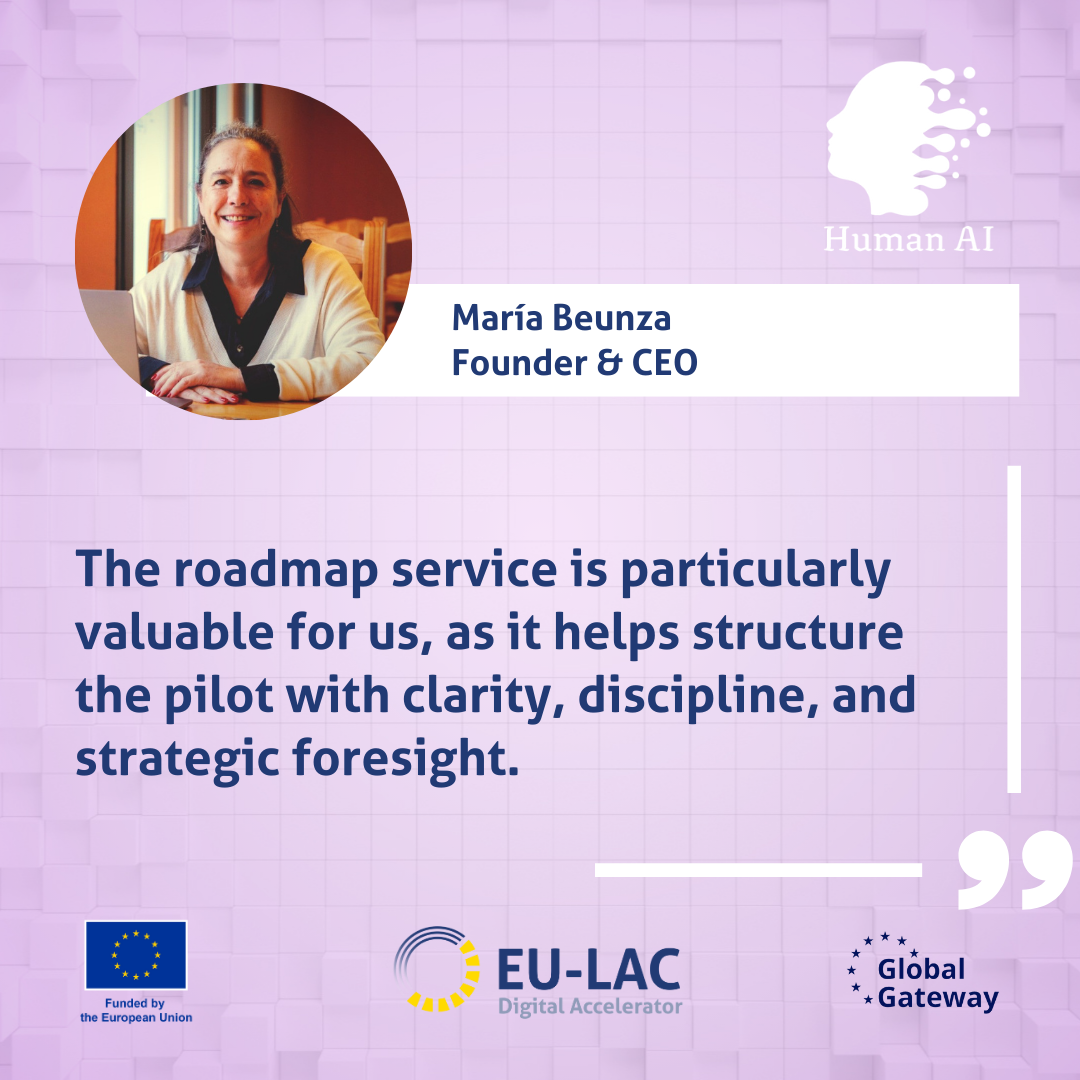
This service will consist in defining a straightforward methodology to validate Human AI’s NLP-based assessments at scale. The plan will integrate academic, employability, and well-being KPIs as well as strong governance and coordination across Spain and Colombia teams.
Such criteria will allow the pilot to demonstrate feasibility within a compressed timeline.
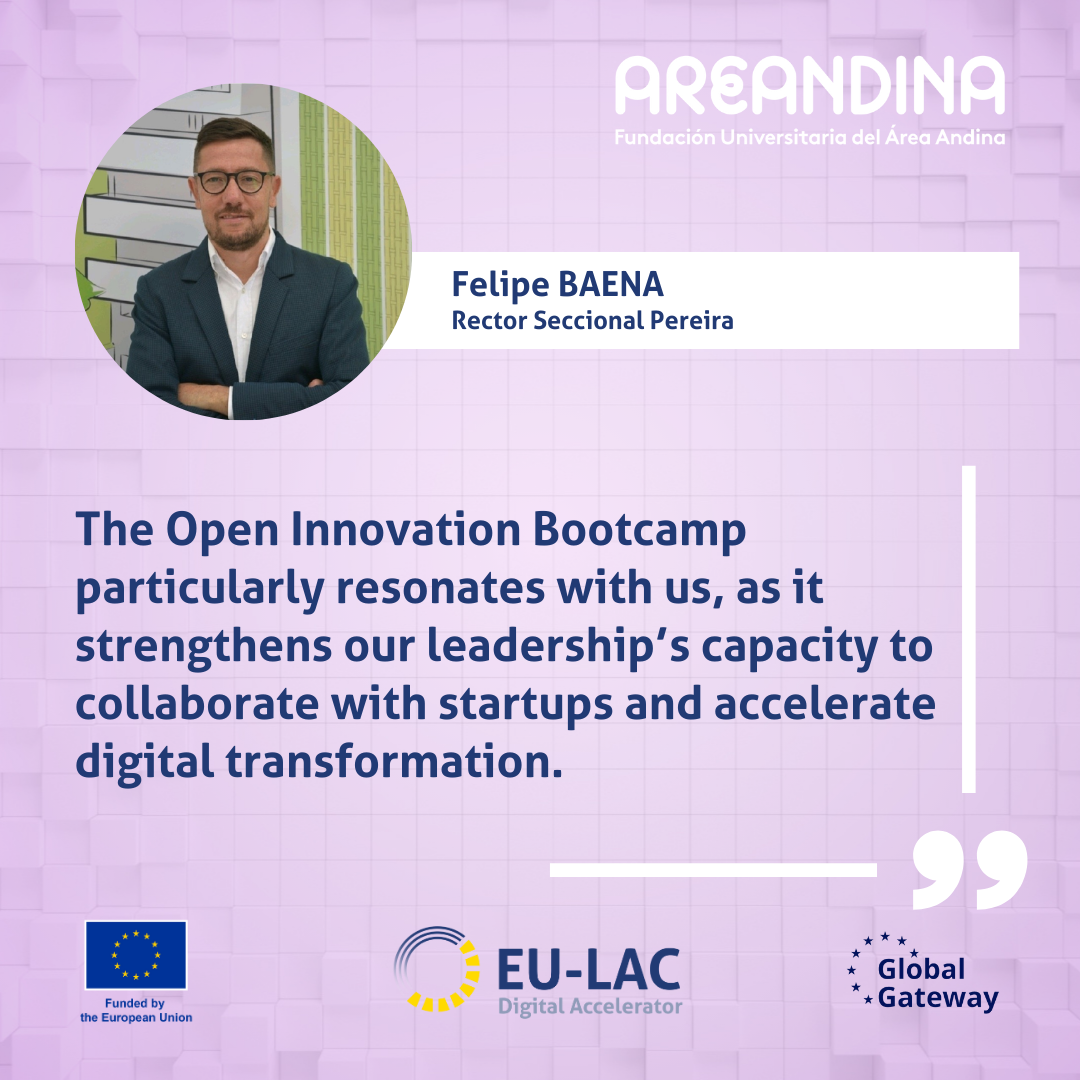
- Service n°2: Open innovation bootcamp
The Bootcamp equips Areandina’s leadership with innovation and corporate venturing capabilities, strengthening internal capacity to work effectively with startups.
In practice, the Bootcamp will help in:
– Managing PoC scaling (turn a small pilot into something the organisation can roll out across the whole organisation)
– Internal “buy-in” (get the right people inside the corporate to support the collaboration)
– Cross-functional adoption (map all impacted teams, adapting the solution to their workflows, coordinating legal, IT, operations, and business units)
- Service n°3: Access to public funding
The EU-LAC Digital Accelerator will here provide personalised guidance to identify international funding opportunities to extend or scale the PoC:
– Identify European, Latin American, and Caribbean funding stakeholders suitable for expanding socioemotional-skill certification models
– Structure financial strategies for multi-campus deployment in 2026
– Prepare the partnership for regional expansion to other universities in Colombia and Latin America.
For Areandina, building readiness and resilience for the job market; For Human AI, validating a reference customer in Latin America
| University Areandina (Corporate) |
Human AI |
|
|