Judith Tsimi represented the EU-LAC Digital Accelerator at the Rio Innovation Week (12-15 August 2025), one of the largest innovation and technology gatherings in Latin America and the Caribbean.
She spoke on the panel “Unveiling Frontiers” alongside Karen Piñeros, Co-founder of Black Communications, and Leonardo Neto, CEO of Usina de Startups.
Together, they discussed the challenges and opportunities of EU-LATAM collaborations and how innovation ecosystems can find common ground to grow together and generate real impact on their respective economies.
Partnerships between European, South American, and Caribbean companies pave the way for complementary know-how and resources, offering a valuable testing ground and access to rapidly growing markets. These collaborations facilitate knowledge transfer, local adaptation of innovations, and the development of solutions with significant social and environmental impact. They also strengthen the international competitiveness of the stakeholders involved and accelerate their global reach.
As part of its mission to strengthen transatlantic innovation links, the EU–LAC Digital Accelerator undertook a strategic immersion at Rio Innovation Week 2025, one of the largest technology and entrepreneurship events in Latin America. This mission aimed to deepen the programme’s understanding of Brazil’s innovation landscape, source high-quality startups aligned with thematic challenges, and consolidate Brazil’s role as a gateway to broader South American ecosystems.
Brazil — accounting for nearly 30% of Latin America’s GDP and ranked 50th in global innovation (GII 2024) — is a strategic anchor for EU–LAC. São Paulo hosts the region’s only Science & Technology Cluster in the global Top 100, and Brazil’s dynamic fintech sector alone attracted nearly $900M in 2024, underscoring its role as a driver of regional innovation.
Against this backdrop, Rio Innovation Week offered the ideal platform to source solutions in smart manufacturing, cleantech, healthtech, fintech, and space technologies, while mapping new partners across Brazil’s fast-growing innovation economy.
Key Stakeholders Engaged – Mapping Brazil’s Innovation Landscape:
1. Maravalley Hub – The Emerging Innovation District of Rio.
Located in the renewed Porto Maravalley area, the hub is designed to become Latin America’s largest innovation district, inspired by international models like Station F. It hosts universities, corporates, VCs, incubators and public actors under a multidisciplinary innovation infrastructure focusing on:
- AI and data-driven innovation
- Smart cities
- Green and sustainable technologies
- Fintech and digital industries
Maravalley is a natural landing point for identifying Brazilian startups and high-potential challenges, while also enabling new links with public-sector innovation agendas.
2. TideWise – Autonomous Marine Robotics for Caribbean Challenges
The mission included a visit to TideWise, one of Brazil’s leading autonomous maritime robotics companies and part of the “100 Open Startups” ranking.
TideWise develops unmanned surface vehicles (USVs) capable of ocean monitoring, hazard detection, and environmental response. This technology has a direct application for the Caribbean, notably in tracking, anticipating, and mitigating sargassum seaweed influxes, a critical ecological and economic challenge.
It represents a concrete example of technology transfer from Brazil to Caribbean territories, offering a basis for multi-stakeholder pilot projects.
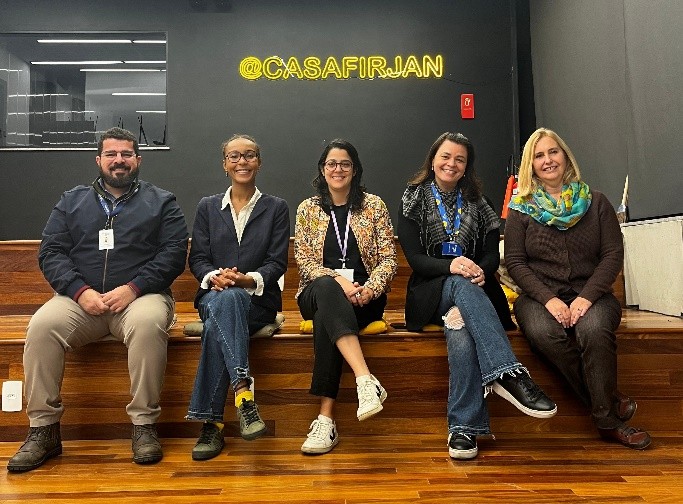
3. Casa Firjan – Industrial Innovation and Digital Fabrication
Casa Firjan, Rio’s flagship innovation hub, provided a strategic overview of how Brazil supports Industry 4.0, sustainability, and digital transformation for SMEs.
Through initiatives such as Conecta Lab – Aceleradora Firjan IEL, the hub offers:
- industrial prototyping and testing spaces,
- manufacturing and digital fabrication tools (FabLab),
- mentorship and business acceleration,
- open access programmes for early-stage entrepreneurs,
- applied research on labour, technology, and social innovation.
4. Usina de Startups – Regional Engine of Open Innovation
Usina de Startups, active across Brazil, Peru, Chile and Haiti, is a key operational partner for corporate innovation programmes in Latin America.
It specialises in:
- challenge-driven corporate acceleration,
- rapid prototyping and pilot implementation,
- scaling solutions across multiple markets,
- connecting corporates, SMEs, VCs, and mature startups.
Usina acts as a regional execution partner, transforming challenge ideas into tangible POCs with agility and cross-market reach.
High-Quality Startup Sourcing – The 100 Open Startups Arena
The 100 Open Startups Arena at Rio Innovation Week was a core sourcing opportunity.
Through speed-dating sessions, open innovation challenges, and startup showcases, the team identified a set of Brazilian startups highly relevant to EU–LAC challenges:
- VENNX – AI-driven Data Governance
- Simar – Energy consumers ↔ supplier’s efficiency marketplace
- OpenTraxx – Video and geolocation for transport/logistics safety
- Otacom – GovTech & EdTech digital services
- XMobots – Latin America’s leading drone manufacturer (agriculture, defence, mapping)
These startups and more will now be pre-qualified and integrated into the EU–LAC Digital Accelerator pipeline for future challenge cycles.
Regional Visibility & Impact
During Rio Innovation Week, the EU–LAC team co-led a panel titled: “Unravelling Borders: The Convergence of Startup Ecosystems and Technology Events in Colombia, Costa Rica, the Dominican Republic, and Haiti.”
The session, held with innovation leaders, showcased the diversity and dynamism of Latin American innovation hubs. The discussion reinforced EU–LAC’s mission: breaking silos and building bridges between Europe, Latin America, and the Caribbean through co-innovation.
The mission strengthened EU–LAC’s presence in Brazil and laid the foundation for long-term cooperation. Through Rio Innovation Week, the EU–LAC Digital Accelerator deepened its understanding of Brazil’s innovation landscape and reinforced its role as a continental connector, linking Europe, Latin America, and the Caribbean in a shared innovation space.