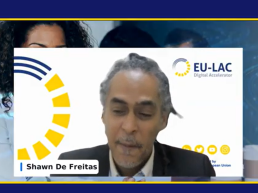
On 28 October 2026, the Delegation of the European Union to Argentina, Argentina’s Secretariat of Innovation, Science and Technology, the City of Buenos Aires and the EU-LAC Digital Accelerator hosted the online webinar “From alliance to market: the EU-LAC Digital Accelerator method for pilots between large companies and startups”.
Moderated by Paco Prieto, Co-Director of the EU-LAC Digital Accelerator, it explained how the programme supports corporate-startup pilots and presented open call #6.
Why public institutions back the programme
Three speakers opened the session:
- Stéphanie Horel, Attaché at the Delegation of the European Union to Argentina, presented the accelerator as one of the five pillars of the EU-LAC Digital Alliance.
- Paula Brennan, International Cooperation Adviser at the Secretariat of Innovation, Science and Technology, spoke on behalf of Secretary Adriana Baravalle and highlighted Argentina’s above-average success rate in European Union programmes.
- Hernán Lombardi, Minister of Economic Development of the City of Buenos Aires, described the city’s technology hubs, including its new artificial intelligence district, and urged companies to use the European Union-Mercosur agreement.
How the programme works
Maika Gorostidi, Co-Director of the EU-LAC Digital Accelerator, explained that the programme connects companies facing digital challenges with startups across the Atlantic.
A European company faces a challenge and needs a startup from Latin America or the Caribbean, and vice versa.
Accepted partnerships receive acceleration services worth up to €30,000, or €40,000 when a Caribbean organisation is involved.
Startups running a proof of concept can also receive a €7,000 grant, plus up to €2,000 for travel and €1,500 for equipment transport.
The first five open calls produced:
- 214 applications
- 144 accepted
- 101 collaboration agreements signed: 64 partnerships accelerated, 37 in progress
Argentine organisations submitted 22 applications, leading to nine signed agreements so far, with three more pending.
Two ways to take part
Federico Kramer, Open Innovation Consultant at the EU-LAC Digital Accelerator, showed the two routes in.
On the Matching Platform, startups can browse more than 70 active corporate challenges and propose a solution.
Existing partnerships can apply directly to open call #6.
Avedian and Asho
Pablo Tabares, Avedian’s co-founder and chief operating officer, explained how the Argentine health technology company entered Europe.
Avedian uses artificial intelligence to predict the length, risk of complications and cost of hospital stays.
Through the programme, it partnered with Asho, a Spanish clinical coding company.
Together, they ran a proof of concept on anonymised data from more than 12,000 stays in a Spanish hospital.
The model indicated that the average stay could fall from 3.7 to 2.8 days, potentially saving that one hospital € 900,000.
Avedian now uses these results to approach around 200 hospitals, mainly in Spain and Portugal.
What the audience asked
The audience’s questions clarified four points:
- The corporate, not the accelerator, decides which startup it works with.
- Results belong to the startup and the corporate.
- Corporates pay nothing, as the European Commission fully funds the programme.
- Public bodies cannot be the corporate partner.
As Hernán Lombardi put it, grants matter, but partnerships succeed through dialogue and mutual learning.
Open call #6 closes on 30 November 2026 and is open to corporates and startups that already work together.
You can watch the full webinar recording below: