Accessibility tech has come far, but it’s still missing sign language
Asteroid Technologies is an Argentinian company that builds “communication accessibility” technology.
In other words, technology that helps people with disabilities express themselves and understand others more clearly.
Its main product is an app called Háblalo, which converts text to speech and speech to text.
This matters for people who are Deaf, hard of hearing, or have speech difficulties, since a normal conversation with a stranger becomes possible without sign language or lip-reading.
But it has a gap: it doesn’t yet let Deaf users type or navigate using sign language as their natural input.
Sign language is not just gestures. It is a full language with its own grammar, recognised as an official language in New Zealand, South Africa, and Iceland.
For many Deaf people, resorting to sign language on a digital interface would be easier and faster than typing.
However, if a Deaf person wants to use a machine such as an ATM, an airport check-in kiosk, or a hospital reception screen, they still have to fall back on writing things down or finding a staff member to help.
A Spanish startup taught a camera to understand a hand
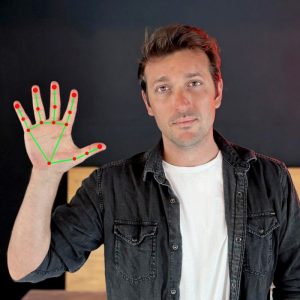
Eldes, a Spanish startup, brings the missing piece: a system that can actually understand sign language.
It works using AI and computer vision and is trained to recognise a specific set of signs and turn each one into an action, just as tapping a button on a screen would.
That signal travels through a secure WebSocket connection. Simply put, it provides a fast, always-open communication channel between two pieces of software. This matters for Eldes’s system because sign recognition needs to feel instant.
By way of illustration, picture a Deaf person standing in front of an airport check-in kiosk.
Instead of typing on a touchscreen or waving down a staff member, they sign “check in” with their hands, and the machine responds immediately, as if they had tapped the screen.
Since sign language is not universal (for example, British Sign Language and Spanish Sign Language are different languages), the system is designed to be retrained for whichever national sign language a given country uses.
Because the technology works as a layer that can be added to various apps, kiosks, and customer-facing screens, it could be rolled out across banks, airports, hospitals, and public offices.
The EU-LAC Digital Accelerator steps in to ensure the idea will work in the real world
- Service n°1: PoC design & Prototyping
Does this idea actually work in the real world before anyone spends serious money scaling it up? This means designing a small-scale test and identifying hypotheses, success criteria, KPIs, and testing protocols to determine feasibility and improvements.
For instance:
– Hypothesis: Can the camera correctly recognise these signs in real time, under realistic conditions, and reliably trigger the right response on a Háblalo screen?
– KPIs: recognition accuracy (what percentage of signs are read correctly), response speed (how many milliseconds pass between the sign and the on-screen action).
– Success threshold: 90% accuracy with a response time under one second.

- Service n°2: Stakeholder mapping (to find clients in Spain)
Who in Spain would actually buy this, and how do we reach them fast?
This means five mentoring sessions to define a joint value proposition, map stakeholders, prioritise pilot-friendly organisations, and build an engagement plan.
For instance:
– Potential clients by sector: CaixaBank or Santander (banking), a regional health service such as Servicio Madrileño de Salud (healthcare), Renfe or Adif (transport).
– Prioritisation criterion: how fast can an organisation say yes? A single hospital or transport hub can often agree to a pilot in weeks, while a national bank’s procurement can take over a year.
Asteroid wants a feature that works. Eldes, a business that sells.
| ♿ASTEROID TECHNOLOGIES (Corporate) |
🤘🏼ELDES |
|
|