The cost of a foundation design that can’t see what the drill sees
Windmill Structural Consultants is a geotechnical and structural consultancy based in Spain, with offices in Tarragona, Barcelona and Valencia.
The company designs pile foundations. These are vertical concrete or steel columns driven or drilled into the ground to carry a building’s weight down to stable soil.
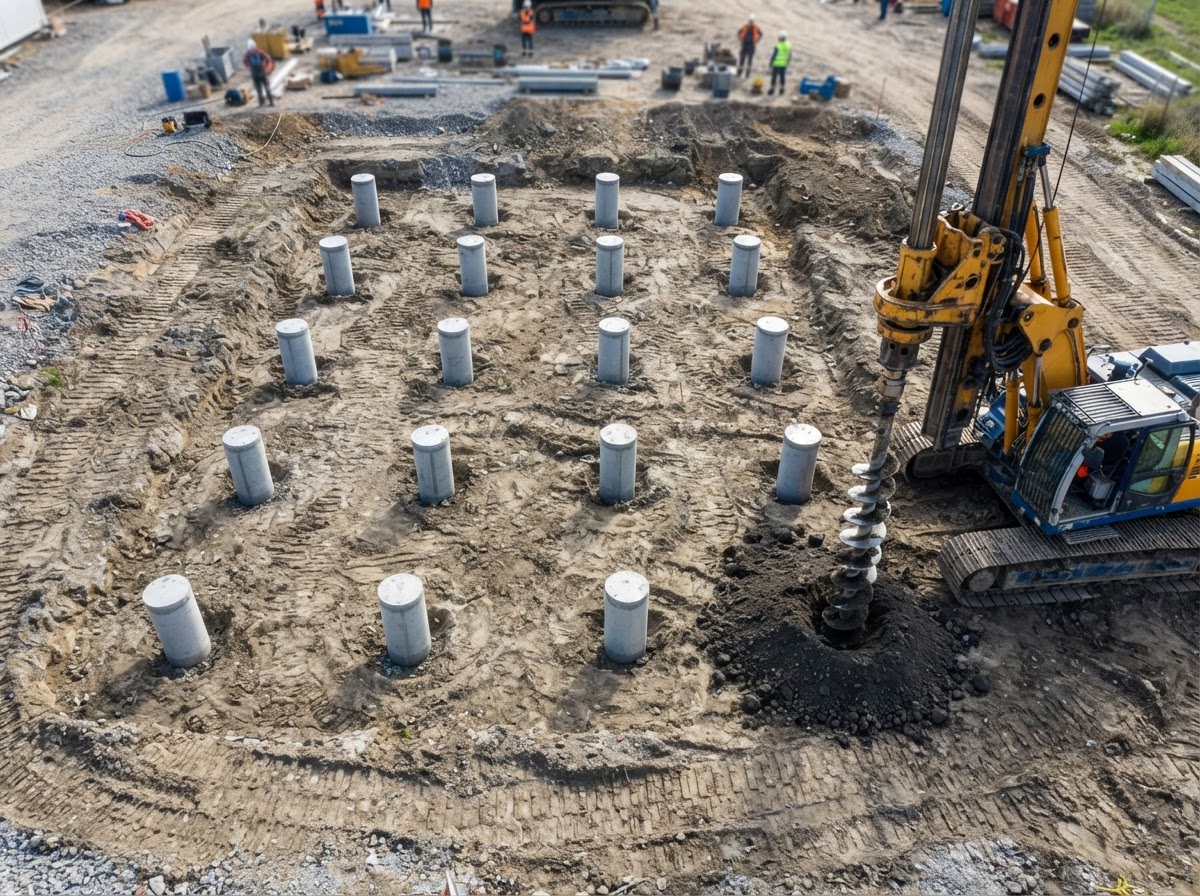
To do this, Windmill engineers rely on 3D soil modelling and automated reporting of soil tests, known as SPT (Standard Penetration Test) and CPT (Cone Penetration Test).
These are two standard methods for measuring the strength and density of the ground at different depths.
Nonetheless, it is worth noting that this design stage provides, at best, an estimate based on a limited number of test points.
And once the piling rig arrives and starts drilling, it generates its own stream of data.
This includes:
- Torque (the twisting force the machine applies to turn the drill),
- Rotation rate (how many times the drill turns per minute).
Both variables say something about the ground the drill is passing through. By way of illustration, harder ground requires more torque to turn.
However, nobody is currently comparing that live signal against the original design.
If a pile turns out to be going through unexpectedly soft or hard ground on the day, the design has no way to know, so it keeps relying on the office estimate rather than on what is actually happening underground.
The safe response to that uncertainty is to over-specify every pile (adding extra concrete, extra steel and a wider safety margin)…regardless of whether the ground for that particular pile actually needs it.
This leads to wasted concrete and steel, overcosts, higher CO2 emissions from producing and pouring materials that were not strictly necessary, and lower on-site piling efficiency.
Watching torque and rotation turn into an accurate soil resistance estimate
Ingenium is an engineering consultancy founded in Uruguay that works on civil and industrial projects across several Latin American countries.
The company brings in-house research and development capability and its own geotechnical tools.
Its proposal for Windmill is an algorithm that (1) takes the torque and rotation rate data recorded by piling equipment and (2) uses it to estimate soil resistance.
Ingenium’s algorithm is designed to correlate the machine readings with the geotechnical design parameters set at the office.
It will of course flag where the real ground data and the original design data start to diverge.
At this stage of the partnership, the work is limited to accessing, structuring and analysing previously recorded piling data, rather than live data streamed from a machine on an active construction site.
This is enough to test whether the correlation (between the algorithm’s soil resistance estimate and the geotechnical design parameters set at the office) actually holds before either side needs to invest in integrating new hardware or systems on a live site.
If the correlation holds, engineers get a way to check pile installation against real construction data rather than office assumptions alone, adjusting a design in progress instead of over-specifying every pile as a precaution.
The algorithm still needs a business case (or it just remains a good idea)
- Service n°1: PoC design & Prototyping
This service will help define the PoC’s objectives, the use cases and user needs behind it, the hypotheses to test (can torque and rotation data reliably predict soil resistance?), and the KPIs (e.g. correlation accuracy) or measurable targets (e.g. maximum acceptable error margin), used to judge whether the test has succeeded.

- Service n°2: Business model design
This service is meant to map the customer profile for the algorithm (piling contractors, geotechnical consultancies and construction companies that specify or install deep foundations).
It also supports the partnership in:
– designing the value proposition,
– building a financial model,
– working through a Business Model Canvas.
With this work, Ingenium can convert a positive technical result into a commercial plan.
- Service n°3: Product roadmap & Digital skills
The accelerator eventually maps key stakeholders in the construction sector across five prioritised Latin American countries and reviews the public funding sources available there.
It also organises a focus group with stakeholders in the Colombian construction ecosystem, such as engineering firms and piling contractors, to validate the technology’s technical and commercial potential with the people who would actually purchase it.
What Windmill Structural Consultants and Ingenium walk away with
|
🏗️ Windmill Structural Consultants |
📐 Ingenium |
|
|